

Updated October 2026
If you want one walking pad and no regrets, the WalkingPad A1 Pro is the pad the walking-pad communities land on most: the longest belt of any flat pad here at 47 x 16.5 in, a brushless motor with an honestly published continuous rating, and a deck that folds in half to 32.5 in for storage. If you want hills, the UREVO CyberPad for Home is the pick, the only pad here with automatic incline, up to 14% as stated. On a tight budget, the DeerRun Walking Pad covers the basics for $130 to $200, with one caveat explained below: the same shell is sold under several brand names.
We did not test these pads on a lab bench. We compared manufacturer spec sheets, owner reports and community threads, then split the list two ways: pads the owner communities keep recommending, and strong sellers most competing lists skip. Prices are bands checked in October 2026. Specs in this category are inflated as a matter of routine, so continuous motor ratings are labelled continuous, peak figures are labelled as stated, and capacities are stated figures, not tested facts. One heavily searched brand is missing on purpose: Sperax pads were the subject of a CPSC stop-use warning in April 2026, covered below.
Quick picks
| Walking pad | Best for | Price band | Why it made the list |
|---|---|---|---|
| WalkingPad A1 Pro | Most people | $500–700 | Longest flat-pad belt, folds in half, continuous rating published |
| UREVO CyberPad for Home | Incline training | $400–500 | Automatic incline to 14% as stated, wide belt, brushless motors |
| Egofit Walker Pro M1 | Small desks, apartments | $400–500 | Smallest pad here, fixed 5% incline, desk-only design |
| DeerRun Walking Pad | Tight budgets | $130–200 | The high-volume budget pad, with a rebadging caveat |
| DeerRun A5 Pro | Walking plus light jogging | $280–350 | Rail folds up for 7.5 mph, 300 lb stated capacity |
| LifeSpan TR1200-DT3 | Heavier users, all-day walking | $1,000–1,200 | 350 lb stated capacity, continuous-duty motor, 20 in belt |
| WalkingPad X21 | Folding away completely | $700–900 | Double-folds to under 9 in thick, biggest belt here |
How this shortlist was built
Five checks decided this list. First, belt size from the manufacturer’s spec sheet for every pick, because belt length decides whether your stride fits and is the figure listings hide most often. Second, motor honesty: where a maker publishes a continuous rating we print it; where only a peak figure exists, the copy says “as stated” and treats it as marketing. Third, capacity: the stated figure only, because a pad run near its limit strains, gets louder and wears faster. Fourth, noise: a manufacturer-stated figure or “not published”; no decibel number was borrowed from a review of a different model. Fifth, safety: every model was checked against the CPSC database before shortlisting. That check is why Sperax is not on this list.
1. WalkingPad A1 Pro: best overall
Ask the walking-pad communities which flat pad to buy first and the A1 Pro is the name that comes back; KingSmith, the company behind the WalkingPad brand, effectively created this category, and this is its best-selling pad. The specification that earns the top slot is the belt: 47 x 16.5 in, the longest walking surface of any flat pad here, because a short belt is what makes a pad feel precarious. The deck folds in half for storage.
The motor story is the honest one in this category: KingSmith’s UK store publishes both ratings, 1.25 HP continuous and 3.75 HP peak, brushless, while the US store headlines the peak figure. Control comes via remote, the KS Fit app, or FootSense, which matches belt speed to where you stand on it. The app is the weak point owners name most; treat the remote as primary.
Key facts
- Price band: $500–700 ($499 at WalkingPad’s US store, October 2026)
- Belt: 47 x 16.5 in; folds to 32.5 x 21.5 x 5 in; pad weight 63 lbs
- Motor: 1.25 HP continuous, brushless (3.75 HP peak, as headlined in the US)
- Speed: 0.5 to 3.75 mph; no incline
- Stated capacity: 300 lbs per the current US store (older listings said 220 to 242 lbs)
- Noise: at or under 65 dB in EN957 testing, as stated by KingSmith
- Warranty: 1 year in the US manual
Pros
- Longest belt of the flat pads, and it folds in half
- The rare maker that publishes a continuous motor rating
Cons
- KS Fit app draws consistent glitch complaints from owners
- 63 lbs is not light, whatever the folding suggests

2. UREVO CyberPad for Home: best with incline
Incline is where walking pads usually cheat, with a fixed riser described as a hill programme. The CyberPad does it properly: a motorised incline adjusted from the remote or app, stated at 0 to 14% across nine levels, the steepest automatic gradient in this class. The belt is a healthy 43.3 x 16.5 in, the motors are dual brushless units, and UREVO rates the pad at a stated 350 lbs.
The caveats are size and newness. At 47.6 in long, 70.6 lbs and 8.7 in tall to house the incline mechanism, it will not vanish under a low sofa, and that deck height is worth measuring against your desk. UREVO sells three CyberPad variants with different belts and capacities: confirm which one is in your cart.
Key facts
- Price band: $400–500 ($399.99 at UREVO’s store, October 2026)
- Belt: 43.3 x 16.5 in; body 47.6 x 23.6 x 8.7 in; pad weight 70.6 lbs; does not fold
- Motor: 2.5 HP, as stated (dual brushless; no continuous rating published)
- Speed: 0.6 to 4.0 mph; incline 0 to 14%, automatic, 9 levels, as stated
- Stated capacity: 350 lbs
- Noise: not published as an absolute figure for the Home model
- Warranty: 1 year plus a 180-day extension, per UREVO
Pros
- Real automatic incline, the steepest stated in the class
- Wide belt and brushless motors at a mid price
Cons
- Tall, heavy body; measure your desk and storage space
- Three similar variants make mis-ordering easy

3. Egofit Walker Pro M1: best for small desks and apartments
The Egofit is the specialist here: the smallest motorised pad on the list at 38.4 in long, fully assembled out of the box, and built for one job, slow desk walking in a small room. The motor sits tucked under the front of the deck, so your toes do not clip it mid-stride, and a fixed 5% incline, as stated, makes desk walking cost a little more effort than flat walking.
The trade is belt length. At 34.25 in, the belt is nearly 13 in shorter than the A1 Pro’s, and short decks are what Consumer Reports flagged in its walking-pad testing, because stepping off the back of the belt is how people lose balance. If you are tall or long-striding, this is not your pad. Capacity is also the lowest here, at a stated 220 lbs.
Key facts
- Price band: $400–500
- Belt: 34.25 x 16.5 in; body 38.4 x 21.9 x 6.9 in; pad weight 48.5 lbs
- Motor: 2.0 HP, as stated
- Speed: 0.6 to 3.1 mph; fixed 5% incline, as stated
- Stated capacity: 220 lbs
- Noise: under 70 dB at maximum speed, as stated by Egofit
- Warranty: 1 year
Pros
- Smallest footprint here; fits desks and rooms nothing else fits
- Fixed incline and a tucked motor, designed purely for desk walking
Cons
- 34.25 in belt is too short for tall users or long strides
- 220 lb stated capacity, the lowest on this list

4. DeerRun Walking Pad: best budget, with a caveat you should know
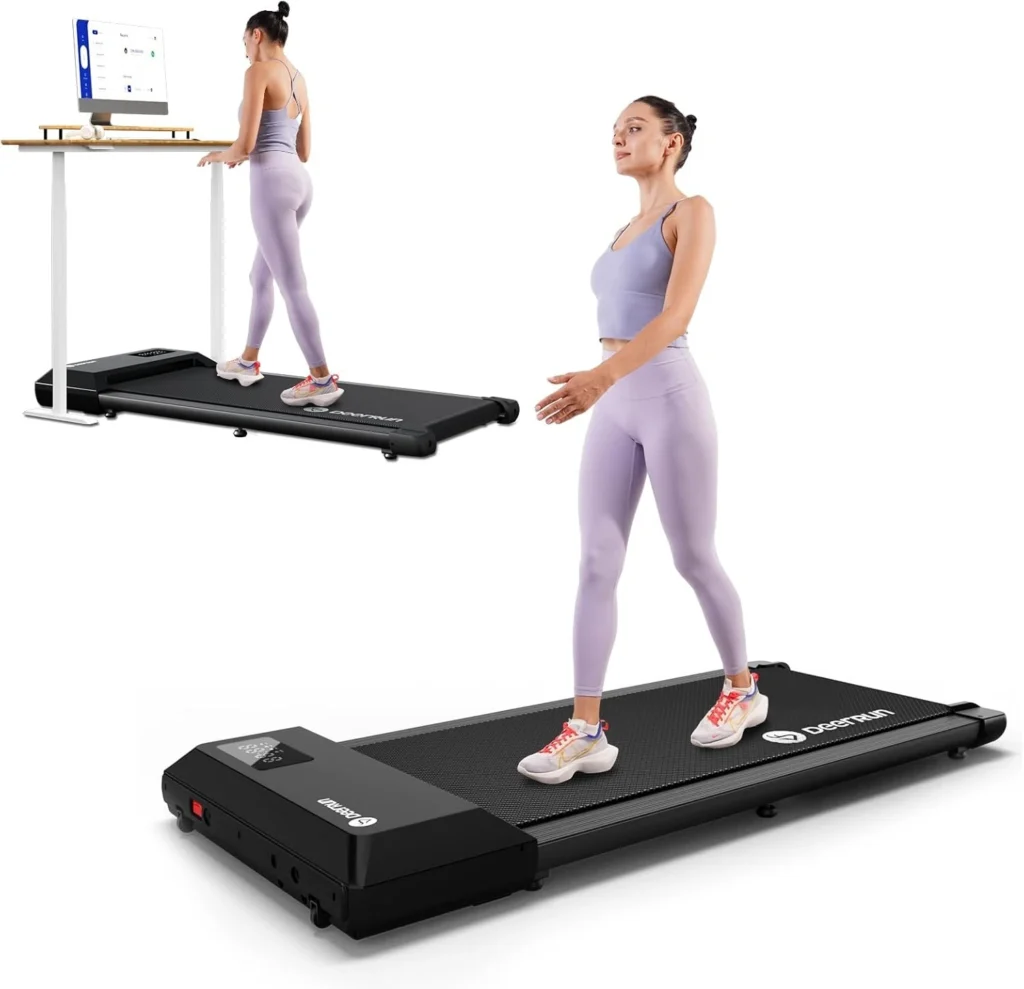
DeerRun is the budget name buyers actually search for, and its basic pad is the volume seller in the $130 to $200 band: a flat, remote-controlled pad with a stated 2.5 HP motor, a 265 lb stated capacity and a walking surface of about 35.4 x 15.75 in. As a first pad for desk steps, it does the job its owners bought it for. The recurring annoyances in owner reports are belt drift and total remote dependence: a lost remote is a stopped pad.
The caveat gets its own section below: this pad is one badge on a shared shell, sold under a crowd of brand names while the printed capacity changes with the badge. DeerRun is the badge we would buy of the family, but go in knowing the hardware is shared.
Key facts
- Price band: $130–200
- Belt: about 35.4 x 15.75 in; weight about 45 lbs
- Motor: 2.5 HP, as stated (peak class; no continuous rating published)
- Speed: 0.6 to 3.8 mph; no incline
- Stated capacity: 265 lbs (the same shell is printed at 250 to 300 lbs under other badges)
- Noise: under 45 dB, as stated in listing copy
Pros
- The lowest price here for a recognised budget brand
- Simple, light, slides under a bed or sofa
Cons
- Belt drift and total remote dependence in owner reports
- Shared shell: the specs are only as good as the badge’s honesty
5. DeerRun A5 Pro: best if you also want to jog
The A5 Pro is a different machine from the budget pad above, despite sharing a badge. It is a 2-in-1: flat, it works as an under-desk pad up to 3.8 mph; fold the handrail up and it becomes a small treadmill good for a stated 7.5 mph, a light jog, not a run. The stated capacity is 300 lbs, the stated motor figure 3.0 HP, Amazon’s listing data gives a deck of about 43 x 16 in, and the listing states a 2-year warranty.
Be clear-eyed about the format’s costs. At 54.2 in long and 61.5 lbs, this is a small treadmill that lives in a room, not a pad that disappears; stored, it is still its full length at 5 in thick. As a desk pad that can do a weekend jog, it is the value pick of the format.
Key facts
- Price band: $280–350
- Belt: about 43 x 16 in, as listed; body 54.2 x 25.5 x 5 in, rail folded; pad weight 61.5 lbs
- Motor: 3.0 HP, as stated (no continuous rating published)
- Speed: 0.6 to 3.8 mph rail down, up to 7.5 mph rail up; no incline
- Stated capacity: 300 lbs
- Noise: not published
- Warranty: 2 years, per the Amazon listing
Pros
- Two machines in one footprint class: desk pad plus light jogging
- 300 lb stated capacity and a 2-year stated warranty
Cons
- Full length even when stored; it lives in the room
- 7.5 mph is a jog on a short deck, not running

6. LifeSpan TR1200-DT3: best for heavier users and all-day walking
Every other pad here is a consumer gadget; the LifeSpan is office equipment, and the honest answer for heavier users. Start with the motor: 2.25 HP continuous duty, a true continuous rating in a category where almost nobody publishes one. The stated capacity is 350 lbs, the belt is the widest and one of the longest here at 20 x 50 in, and the warranty is in another league: lifetime frame, 3 years motor, 2 years parts, 1 year labour. LifeSpan rates it for about six hours of walking a day.
The costs are literal and physical. The band is $1,000 to $1,200, and at about 118 lbs, not folding, and 63 in long, it is furniture. Reviewers flag the console as the least reliable part of the package. If you are near a cheaper pad’s stated limit, this is the machine whose numbers were written for you.
Key facts
- Price band: $1,000–1,200
- Belt: 50 x 20 in; body about 63 x 29 in; weight about 118 lbs with console; does not fold
- Motor: 2.25 HP continuous duty DC, a true continuous rating
- Speed: 0.4 to 4.0 mph; no incline (LifeSpan argues desk walking should stay flat)
- Stated capacity: 350 lbs
- Noise: not published as a decibel figure
- Warranty: lifetime frame, 3 years motor, 2 years parts, 1 year labour
Pros
- The honest heavy-duty pick: continuous-duty motor, 350 lb stated capacity, 20 in belt
- Warranty and daily-duty rating no other pad here approaches
Cons
- $1,000 plus, and it is permanent furniture
- Console reliability is the recurring reviewer complaint

7. WalkingPad X21: best for folding away completely
The X21 folds twice. KingSmith’s double-fold design collapses the deck and the uprights together, so a machine with a 47.6 x 18.1 in belt, the longest and widest walking surface here, packs down to 27.9 x 37.6 x 8.9 in and stands in a closet or against a wall. Nothing else here stores this small while offering this much belt. The handrail carries an OLED display and speed dial, and the 7.5 mph top speed allows light jogging with something to hold.
Hold the trade-offs clearly. The handrail does not fold flat under a desk, so as an under-desk pad you lose the console and control it from the app; as a desk machine the A1 Pro is the better KingSmith. Capacity is a stated 240 lbs, the second lowest here, and at 81 lbs it is heavy for its class.
Key facts
- Price band: $700–900
- Belt: 47.6 x 18.1 in; folded 27.9 x 37.6 x 8.9 in; pad weight 81 lbs
- Motor: 1.25 HP, as stated (brushless; US listing maximum)
- Speed: 0.6 to 7.5 mph with the handrail up; no incline
- Stated capacity: 240 lbs
- Noise: not published by KingSmith for the US model
Pros
- Double-fold storage no rival matches, with the biggest belt here
- Handrail and 7.5 mph top speed for light jogging
Cons
- 240 lb stated capacity and an 81 lb machine to move
- Handrail format makes it the weaker under-desk KingSmith

All 7 walking pads compared
| Walking pad | Price band | Belt (L x W) | Stated capacity | Motor, as published | Top speed | Pad weight |
|---|---|---|---|---|---|---|
| WalkingPad A1 Pro | $500–700 | 47 x 16.5 in | 300 lbs | 1.25 HP continuous, brushless | 3.75 mph | 63 lbs |
| UREVO CyberPad for Home | $400–500 | 43.3 x 16.5 in | 350 lbs | 2.5 HP, as stated | 4.0 mph | 70.6 lbs |
| Egofit Walker Pro M1 | $400–500 | 34.25 x 16.5 in | 220 lbs | 2.0 HP, as stated | 3.1 mph | 48.5 lbs |
| DeerRun Walking Pad | $130–200 | 35.4 x 15.75 in | 265 lbs | 2.5 HP, as stated | 3.8 mph | About 45 lbs |
| DeerRun A5 Pro | $280–350 | 43 x 16 in, as listed | 300 lbs | 3.0 HP, as stated | 7.5 mph | 61.5 lbs |
| LifeSpan TR1200-DT3 | $1,000–1,200 | 50 x 20 in | 350 lbs | 2.25 HP continuous duty | 4.0 mph | About 118 lbs |
| WalkingPad X21 | $700–900 | 47.6 x 18.1 in | 240 lbs | 1.25 HP, as stated | 7.5 mph | 81 lbs |
Capacities are stated figures, and motor numbers are printed the way each maker publishes them. Re-check on the live listing before buying.
Walking pad or full treadmill?
A walking pad tops out at desk pace to a brisk walk, 4 mph at most for the flat pads here, and the two models that go faster do it with a handrail on a short deck: jogging territory, not running. A full treadmill gives you a longer belt, a real console, incline ranges and running speeds, and takes a room corner permanently to do it. If your goal is steps during the working day and a machine that stores away, the pad is the right tool at a fraction of the price. If you run, or intend to, buy the treadmill instead.
Why three brands sell the same pad
Shop the budget end of this category for an afternoon and a pattern emerges: the same pad keeps appearing under different names. The clearest case is the shell family our DeerRun pick belongs to. A belt of about 35.5 x 15.5 in, a body of about 45 x 20 in, a weight of about 42 to 45 lbs, a 2.5 HP peak claim, a 3.8 mph ceiling and the same companion app (PitPat) appear in the manuals and listings of DeerRun, SupeRun and a rotating cast of Amazon-native badges, because the machines come off shared production lines. What changes with the badge is the paperwork: the same shell is printed at 250 lbs in one manual, 265 lbs in a listing and 300 lbs in another.
None of that makes the hardware bad; thousands of owners walk on these pads daily. It means two things. First, a list that recommends three of these badges as three different products is padding itself, so we count the shell once. Second, when the hardware is shared, the badge is the product: buy the version with the storefront, warranty and returns process you trust most, and treat any capacity printed above the family’s common figures as a claim about paper, not the machine.
The brand we left out: Sperax and the April 2026 CPSC warning
Sperax is one of the most searched walking-pad brands, and it is not on this list, for the same reason the Bowflex 552 is missing from our dumbbell guide. On April 16, 2026, the US Consumer Product Safety Commission warned consumers to stop using Sperax walking pads and treadmills (models Pro, Q1, RM-01 and RM-02) immediately. The agency cited 201 reports of pads changing speed suddenly or stopping dead, causing at least 66 falls or injuries including a concussion, and 573 reports of overheating, fires and other thermal incidents, including minor burns. The importer declined to agree to a recall the CPSC found acceptable, so there is no repair or replacement programme; the warning itself is the remedy, and Amazon has refunded many buyers who disabled their pads.
If you own one of the named models: stop using it, unplug it, and check the model label near the power switch rather than trusting the listing name you bought under. Do not sell it on or give it away. The wider lesson applies across the budget half of this category: a walking pad is a motorised belt you stand on with nothing to hold, so the maker’s safety record is a specification too, even though it never appears in the listing’s bullet points.
Complete your home gym
A walking pad covers the steps half of a small home gym: the background movement a desk job removes. The other half is strength, and it needs about the same two square feet. Our guide to the best adjustable dumbbells applies the same method, community recommendations first and honest caveats included, to the lifting side of the room: one pair of dumbbells that replaces a rack, next to the pad that replaces the commute.
FAQs
Can you run on a walking pad?
On the flat pads, no. They top out between 3.1 and 4.0 mph, which is walking, and their belts and motors are built for walking loads. The two handrail models here, the A5 Pro and the X21, reach 7.5 mph and allow light jogging in short sessions. If running is the goal, buy a treadmill; a pad bought for running is the most common disappointment in this category.
How loud is a walking pad in an apartment?
It depends which noise you mean. Motor noise is the figure makers publish, and the stated figures here run from the A1 Pro’s tested at-or-under 65 dB to listing claims under 45 dB that we print as claims. In a real apartment, footfall through the floor usually carries further than the motor, which is why a mat under the pad matters more than any decibel badge. Walk at sensible hours and a pad is a good neighbour.
What belt size do I actually need?
Length first. A belt under about 40 in suits shorter strides and slow desk walking; taller users, and anyone who walks briskly, should look at 43 in and up. The longest belts here are the LifeSpan’s 50 in and the X21’s 47.6 in. Width matters less at walking pace: 16.5 in feels secure, and the LifeSpan’s 20 in is more forgiving. If you are over about six feet tall, be careful with the Egofit’s 34.25 in belt.
I weigh close to a pad’s stated capacity. Is it fine?
We would not run a pad at its stated limit daily. Stated capacity is a maximum, not a comfort rating: a motor working near its ceiling runs hotter and louder and wears faster, and the strain shows up first as belt hesitation. If you are within about 30 lbs of a pad’s stated figure, step up to the next capacity class. That is why the LifeSpan is our heavier-user pick despite the price.
How many steps will I actually get at a desk?
At a comfortable working pace of 1.5 to 2 mph, expect roughly 3,000 to 4,000 steps an hour, and most desk walkers settle into two to three walking hours a day rather than a full shift: 6,000 to 10,000 added steps on the days you use the pad. It does not ask for workout time, it converts sitting time.
Black Friday 2026: Our sister site rounded up the year’s proven best sellers here: Black Friday Deals 2026: 17 Best Sellers Everyone Actually Needs.
4 thoughts on “Best Walking Pads in 2026: Quiet, Compact Pads for Desks, Apartments and Daily Steps”