
Disclosure: This post contains affiliate links. If you buy through them, Voralist may earn a small commission at no extra cost to you. Prices checked November 2026.
If you just want the answer: buy the Westinghouse ePX3500 (2500 max PSI, about $169) for a typical house, and the Sun Joe SPX3000 (2030 max PSI) if the budget is tight. The other five picks cover specific cases: heavy concrete, a premium brushless motor, delicate car paint, and a wall-mounted unit that ends hose wrestling for good.
One thing to know first. Boxes print maximum PSI and maximum GPM, and you never get both at once. Working pressure (rated PSI) is the honest number. Every pick here publishes rated figures or holds a PWMA or CETA certification, and each is a model owners in r/pressurewashing and homeowner forums keep recommending after the first season.
Quick Comparison
| Pick | Model | Max PSI | Max GPM | Weight | Best for |
| Best overall | Westinghouse ePX3500 | 2500 | 1.76 | 18.7 lb | Most houses, mixed jobs |
| Best budget | Sun Joe SPX3000 | 2030 | 1.76 | 25.1 lb | First washer, light to medium jobs |
| Most powerful | Westinghouse WPX3000e | 3000 | 1.76 | 36.8 lb | Stained concrete, big driveways |
| Best brushless | Greenworks Pro 2700 (GPW2702A) | 2700 | 2.3 | 50.7 lb | Frequent, heavy use |
| Best compact | Karcher K1700 | 1700 (2125 max) | 1.2 | 20.7 lb | Small homes, storage-tight garages |
| Best for cars | Adams Polishes Active Pressure Washer 2.0 | 1800 peak | 2.0 | 24 lb | Detailing, foam cannon work |
| Best wall mount | Giraffe Tools Grandfalls Plus | 2900 | 2.2 | 46.7 lb | Permanent garage setup, 100 ft reach |
1. Westinghouse ePX3500: Best Overall

2500 max PSI (2000 rated) | 1.76 max GPM (1.2 rated) | 25 ft hose | 18.7 lb | About $169
The ePX3500 is the machine we would hand to a neighbor who asked for one washer that does everything reasonably well. Its rated output of 2000 PSI at 1.2 GPM handles algae on siding, mud on a walkway, and road salt under a car. The four-wheel anti-tipping base solves the worst habit of tall upright washers: falling over every time you tug the hose. At under 19 pounds it carries easily, and the 20.3 oz soap tank plus five nozzles (0, 15, 25, turbo, soap) cover the standard job list.
Owner complaints are consistent. The 25 ft hose is stiff out of the box and kinks until it has been laid flat in the sun a few times. A minority of owners report weeping at the pump outlet in the first months, which the 3-year warranty generally handles. The soap tank is small, so a full house wash means refills.
Pros
- Honest rated specs
- Anti-tip base
- Light
- 3-year warranty
- Strong price
Cons
- Stiff hose
- Small soap tank
- Occasional early leaks reported
Price: about $169.
Check Price on Amazon2. Sun Joe SPX3000: Best Budget Pick

2030 max PSI | 1.76 max GPM (1.2 rated) | 20 ft hose | 35 ft cord | 25.1 lb | See price on Amazon
The SPX3000 has been the default first pressure washer recommendation on Reddit for years, and owners report running them for 100 hours or more on neighborhood driveways. You get a 14.5-amp motor, dual removable detergent tanks (rare at this price), five nozzles, and a 35 ft cord that partly makes up for the shorter 20 ft hose. For decks, patios, fences, and cars, it is genuinely enough machine.
The complaints are just as well documented. The plastic garden hose inlet cracks or leaks on many units; a brass inlet adapter is the standard fix. The GFCI plug trips on some older outdoor circuits. Soap only draws through the low pressure soap nozzle. Buy it knowing the inlet fitting is a wear item.
Pros
- Proven over years of owner use
- Dual soap tanks
- Long cord
- Cheap to replace
Cons
- Plastic inlet fitting leaks
- Shorter hose
- GFCI trips reported
Price: see price on Amazon.
Check Price on Amazon3. Westinghouse WPX3000e: Most Powerful Electric Here

3000 max PSI (2600 rated) | 1.76 max GPM (1.1 rated) | 25 ft hose | 35 ft GFCI cord | 36.8 lb | $279.99
When a driveway has years of tire marks and oil spots, rated pressure moves the work along, and the WPX3000e’s 2600 rated PSI is the highest working pressure in this roundup. The induction motor is the other reason to pay more: it runs cooler and typically outlasts the universal motors in cheaper washers. Add a steel frame, 10-inch never-flat wheels, and a 0.45 gallon soap tank.
Be clear about the trade-offs. At 36.8 lb it is a roll-it machine, not a carry-it machine (ignore any listing claiming 19 lb; that figure is a known data error). Rated flow is only 1.1 GPM, so rinsing large areas takes patience, and it costs close to double the ePX3500.
Pros
- Highest rated PSI here
- Induction motor
- Steel frame
- Big soap tank
Cons
- Heavy
- Rated GPM is modest
- Price
Price: $279.99.
Check Price on Amazon4. Greenworks Pro 2700 Brushless (GPW2702A): Best for Frequent Heavy Use

2700 max PSI | 2.3 max GPM (1.2 at full pressure) | 25 ft hose | 35 ft cord | 50.7 lb | $379.99
Greenworks builds this one like light commercial gear: a brushless motor, a cast aluminum axial cam pump, a steel frame, and JETTFlow sensing that adjusts output to the nozzle you click in. The flow figure needs translating: you get 2.3 GPM at low pressure for fast rinsing, or 1.2 GPM at the full 2700 PSI for cutting grime. On cleaning units (PSI times GPM at working settings) this is the strongest all-round cleaner here, and replacement pump parts are available, which matters more than any spec after year three.
The costs are money and weight. At about $380 and over 50 lb, it only makes sense if you wash often or have a lot of concrete. Owners also note a brief trigger delay as the smart motor spools up.
Pros
- Brushless motor
- Strongest working output
- Parts availability
- PWMA certified
Cons
- Expensive
- Very heavy
- Slight trigger delay
Price: $379.99.
Check Price on Amazon5. Kärcher K1700: Best Compact Pick

1700 PSI TruPressure (2125 max) | 1.2 GPM | 20 ft hose | 20.7 lb | $189.99
Kärcher invented this category, and the K1700’s selling point is honesty: its 1700 PSI figure is CETA certified TruPressure, a working number rather than a startup spike. For apartments, townhomes, and small houses, that covers cars, bikes, patio furniture, fences, and light siding work, in a 20.7 lb box that stores on a shelf. The on/off foot switch sounds like a gimmick until you have used one.
Limits are real. The 20 ft hose is the shortest here, so larger homes mean moving the unit often, and 1.2 GPM makes big driveways slow. Owners flag the plastic fittings as the long-term weak spot.
Pros
- Certified honest PSI
- Compact and light
- Foot switch
- 3-year warranty
Cons
- Short hose
- Slow on large areas
- Plastic fittings
Price: $189.99.
Check Price on Amazon6. Adam’s Polishes Active Pressure Washer 2.0: Best for Cars
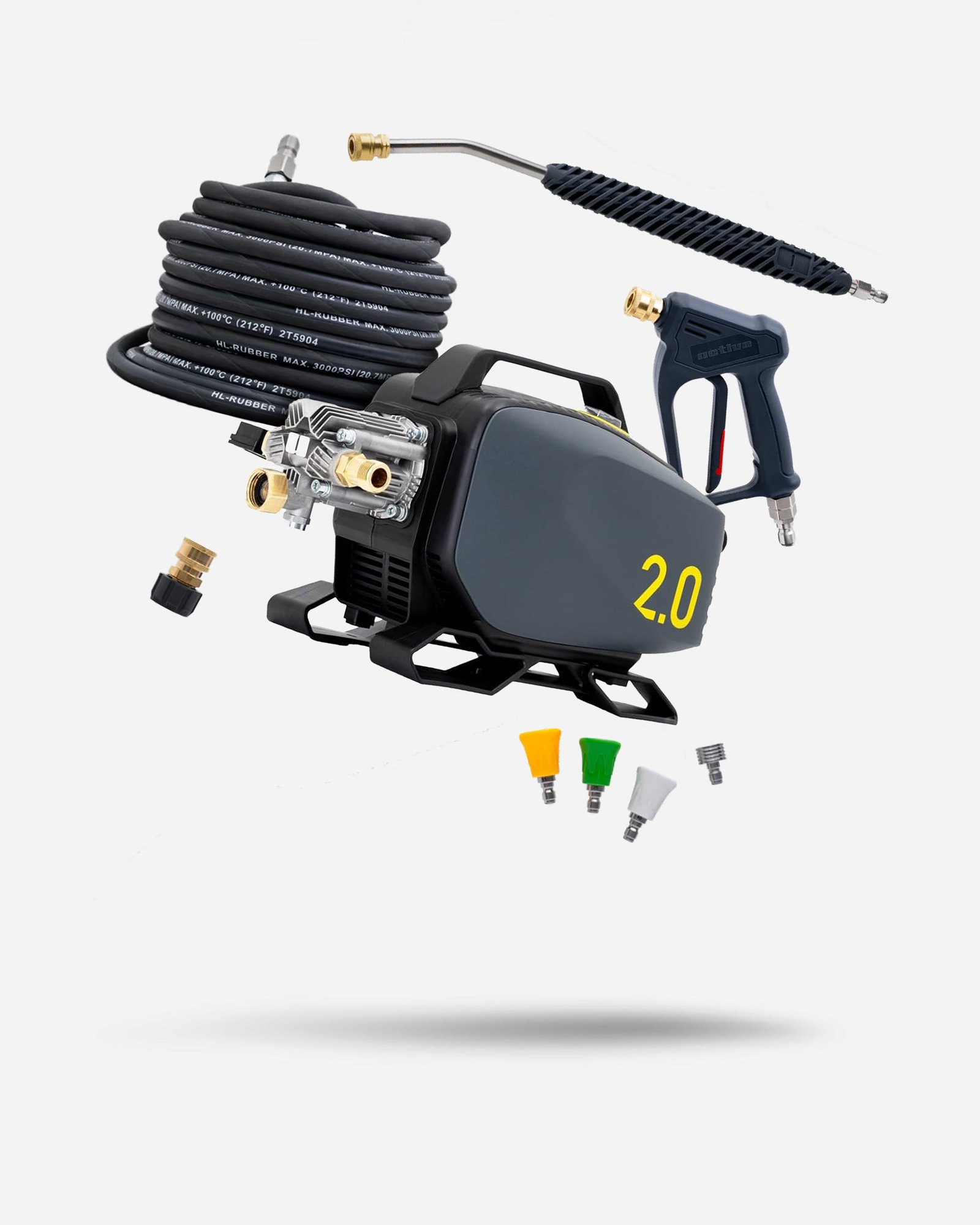
1800 peak PSI (1100 working) | 2.0 GPM | 24 lb | About $249 (kit with foam soap)
Car people shop differently: paint wants flow, not pressure. The Active 2.0 comes from the detailing world (the same platform sold through Obsessed Garage circles) and delivers a genuine 2.0 GPM at roughly 1000 to 1100 working PSI, the sweet spot for foam cannons and safe rinsing. The five-piston pump is smoother and quieter than typical budget pumps, the unit is a compact 24 lb brick, and this Amazon kit bundles Adam’s Mega Foam car soap.
Read the fine print. The 1800 PSI on the box is a peak number; working pressure is about 1100 PSI, the point for cars but the wrong tool for a filthy driveway. The listing rates pump and motor life at about 250 hours: fine for weekend detailing, not for a cleaning business.
Pros
- True 2.0 GPM flow
- Paint-safe working pressure
- Smooth quiet pump
- Compact
Cons
- Weak for concrete
- 250-hour rated pump life
- Pricey for its power class
Price: about $249.
Check Price on Amazon7. Giraffe Tools Grandfalls Plus: Best Wall-Mounted Setup

2900 max PSI | 2.2 GPM | 100 ft retractable hose | 46.7 lb (wall mounted) | See price on Amazon
Every other pick here still leaves you uncoiling a hose, washing, then coiling it again. The Grandfalls Plus bolts to a garage wall and keeps 100 ft of hose on an auto-rewind reel with any-length lock, so it is ready in seconds and reaches the street and driveway from one spot. Output is strong on paper at 2900 max PSI and 2.2 GPM, and the induction motor suits a fixed install. For owners who wash cars weekly, this convenience is the entire point.
It is also the biggest commitment on the list. At 46.7 lb it must anchor into studs or masonry, not drywall alone, and once mounted it never travels. Rewind mechanisms and proprietary fittings mean repairs lean on Giraffe’s own parts channel, not generic hardware store pieces.
Pros
- 100 ft reach with auto-rewind
- No setup or storage hassle
- Strong flow
Cons
- Permanent install
- Heavy mounting job
- Brand-specific parts
Price: see price on Amazon.
Check Price on AmazonHow Much PSI Do You Actually Need?
More PSI is not better. It is only faster on hard surfaces and more destructive on soft ones. Match the job:
- Cars and motorcycles: 1200 to 1900 PSI with a 25 or 40 degree fan nozzle, wand held 12 to 18 inches away. Flow (GPM) does the rinsing, which is why the Adam’s unit above exists.
- Vinyl and fiber cement siding: 1300 to 1600 PSI, spraying downward so water is not driven up behind the panels. Many owners soft wash with detergent and a soap nozzle instead.
- Wood decks and fences: 500 to 600 PSI for softwoods like cedar and pine with a wide fan tip, up to about 1200 to 1500 PSI for dense hardwoods. This is where beginners carve grooves into boards, so test in a hidden corner first.
- Concrete and pavers: 2500 to 3000 PSI with a 15 or 25 degree nozzle, or better, a surface cleaner attachment that holds the jets at a fixed height and prevents zebra stripes.
- Brick and stone: 1500 to 2500 PSI, wand always moving so mortar joints are not blasted out.
- Paint stripping: beyond what homeowner electrics do well. Rent a gas machine instead.
A useful shortcut is cleaning units: PSI times GPM. A 2000 PSI washer at 1.2 GPM (2400 cleaning units) cleans a driveway at about the same pace as a 1700 PSI washer at 1.4 GPM. Flow deserves as much attention as pressure.
Mistakes That Strip Paint and Kill Pumps
- Using the 0 degree red nozzle on wood, cars, or screens. It concentrates the stream into a pencil jet that etches concrete and slices soft surfaces. Most homeowners should leave it in the holder permanently.
- Holding the wand too close. Pressure at the surface climbs fast as distance shrinks. Start 2 feet away and move closer only until dirt lifts.
- Spraying upward under siding or shingles. You push water behind the wall, where it feeds mold. Always spray downward.
- Leaving the pump pressurized or unprotected in winter. Bleed pressure after use and run pump saver antifreeze through the pump before storage. One freeze cracks pump housings; it is the most common way these machines die.
- Using a thin or long extension cord. Voltage drop strains the motor and trips GFCI plugs. Plug into a GFCI outlet directly; if a cord is unavoidable, use a short 12-gauge outdoor cord.
- Washing from a ladder. The trigger kick has knocked plenty of people off. Use an extension wand instead.
- Skipping the inlet filter. Grit from a garden hose wears pump seals. Rinse the inlet screen every few uses.
FAQ
Is 2000 PSI enough for a driveway?
Yes for routine dirt, algae, and tire marks, especially with a surface cleaner attachment. Deeply stained or oil spotted concrete cleans faster at 2600 to 3000 rated PSI, WPX3000e and Greenworks 2700 territory.
Can an electric pressure washer damage car paint?
It can with a narrow nozzle up close. At 1200 to 1900 PSI with a 25 or 40 degree fan tip held a foot or more away, it is the standard method detailers use. Never use the 0 degree or turbo nozzle on paint or cracked clear coat.
Why does my pressure washer keep tripping the GFCI?
Usually a thin or long extension cord causing voltage drop, a shared circuit loaded with other devices, or moisture in the plug. Plug directly into a GFCI outlet on its own circuit first. If it still trips with nothing else running, that is a warranty conversation, not something to bypass.
Electric or gas: which should a homeowner buy?
Electric for almost everyone. It starts instantly, stores indoors, needs no oil or fuel care, and covers every job in the PSI guide except paint stripping and very large concrete areas. Gas earns its keep on farms, long driveways far from outlets, and paid work.
How do I store an electric pressure washer for winter?
Drain the pump and hose, squeeze the trigger to release pressure, disconnect everything, and run pump saver (a lubricating antifreeze made for pressure washers) through the pump until it exits the outlet. Do not skip the pump saver if the garage freezes.
Verdict
For most homes, the Westinghouse ePX3500 is the right buy: honest rated power, light, anti-tip, about $169. On a budget, the Sun Joe SPX3000 remains the proven starter machine; add a brass inlet adapter on day one. Big concrete and frequent use justify the WPX3000e or the Greenworks Pro 2700. Car owners should look at the Adam’s Active 2.0, small homes at the Kärcher K1700, and anyone tired of coiling hoses at the Giraffe Grandfalls Plus. Spend as much thought on the nozzle in your hand as the number on the box, and your siding, deck, and paint will survive the cleaning.
For the floors you should never pressure wash, like indoor hardwood, see our guide to the best vacuum for hardwood floors instead.